
The Mistake Most Homeowners Make First
When a garage door starts binding, scraping, or hanging crooked, the first instinct is almost always to grab a rubber mallet or a pair of pliers and try to bend the track back into place. It feels like a reasonable fix — the track looks slightly bent, so bending it back seems logical, and it's free. The problem is that garage door tracks are calibrated to very tight tolerances. Rollers need to sit in the channel with almost no play, and a track that's been hand-bent back "close enough" often ends up with a kink instead of a smooth curve. That kink creates a new pressure point, which wears out rollers faster and can pull the track loose from its brackets. What starts as a $20 fix often turns into a full track replacement because the metal got worked twice instead of once.
Symptoms That Point to a Track Problem
Track issues rarely show up as one dramatic failure. They usually build gradually, and most homeowners notice the sound before they notice the misalignment itself.
- Grinding or scraping noise as the door opens or closes, especially at a consistent spot in the travel.
- The door sticks or hesitates partway through its cycle, then jerks forward.
- Visible gap between the rollers and the track wall, or rollers that look like they're riding on the edge instead of inside the channel.
- The door looks crooked when fully open — one side higher than the other, or the panels no longer line up square.
- The door has come partially off the track, usually at the bottom curve where the horizontal and vertical sections meet.
Any one of these on its own is worth a look. Several happening together usually means the misalignment has been developing for a while.
What a Technician Checks, in Order
1. Track Alignment First
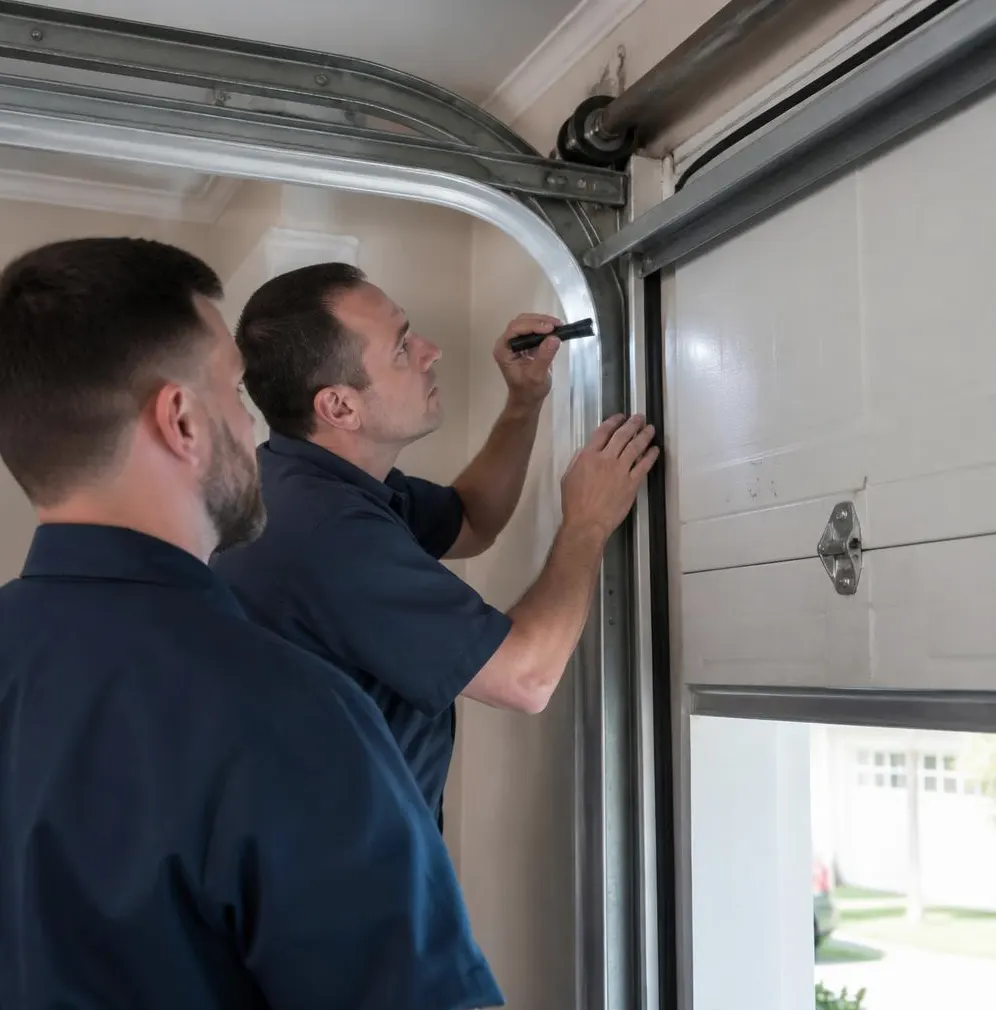
The first thing a technician does is run a level against the vertical tracks and sight down the horizontal tracks to see where the door is actually running out of plumb. This narrows down whether the problem is a single bent section or a broader alignment drift affecting the whole system.
2. Roller Condition
Worn, cracked, or flat-spotted rollers put uneven pressure on the track every time the door cycles. In this area, rollers take a beating from humidity and pine sap residue that builds up around garage openings, especially on homes close to tree lines. A roller that's dragging instead of rolling smoothly will eventually bow the track outward at that spot.
3. Mounting Brackets
Tracks are held to the door frame with brackets and lag bolts. Heavy rain and humidity swings common to this part of North Carolina can work bolts loose over time as wood framing expands and contracts. A loose bracket lets the track shift a quarter-inch here, an eighth-inch there, until the whole track is pulling away from true.
4. Impact Damage
This is the most common cause of a sudden, obvious bend. A car bumper, a ladder, a bike, or debris kicked up during a storm can tap the bottom section of track hard enough to knock it out of shape. With hurricane remnants pushing through inland several times a year, wind-driven branches and yard debris are a real factor here — it doesn't take a direct hit, just enough force to tweak the metal at a weak point.
5. Frame or Foundation Settling
Less common but worth checking on older homes: if the garage slab or frame has settled unevenly, the track mounted to it settles with it. This shows up as a gradual lean rather than a sharp bend, and it tends to come back even after a straightforward realignment unless the mounting points are adjusted to compensate.
6. Rust and Corrosion
High humidity and the kind of standing moisture that collects around garages in this climate can rust a track from the inside of the channel outward. Rust buildup narrows the channel just enough to bind the rollers, and the extra friction puts a steady bending force on the track every time the opener forces the door through that spot.
How Each Fix Actually Works
- Minor misalignment: Loosen the bracket bolts, use a level to reposition the track, retighten to spec. This is a 20–30 minute fix when caught early.
- Worn rollers: Replace with new rollers — nylon rollers run quieter and handle humidity better than steel, which matters given how damp garages get here through summer.
- Loose or bent brackets: Brackets are either re-torqued or replaced outright if the metal has bent along with the track.
- Impact-damaged sections: A localized bend can sometimes be swapped out as a single track section rather than replacing the whole run, which keeps the cost down.
- Severe or repeated bending: Full track replacement on one or both sides, so the door travels evenly and doesn't immediately re-bend the old track's weak point.
- Rust-related binding: Clean and treat the channel, or replace the section if corrosion has pitted the metal enough to compromise its shape permanently.
When to Call Angier Garage Door
If your door is scraping, hanging crooked, or has come off the track even partially, stop using it. Running a door on a bent track stresses the opener, the cables, and eventually the springs, turning a track problem into a multi-part repair. This is a good time to call in Garage Door Repair for a proper diagnosis — we'll check alignment, rollers, and brackets in that order and tell you plainly whether it's a quick adjustment or a section that needs replacing. If the tracks are original to an older door and showing rust or wear across the board, we'll also walk you through whether routine Garage Door Maintenance going forward would help you get more years out of the current setup instead of replacing it piecemeal.
If your garage door in Angier, NC is binding, grinding, or sitting crooked, give Angier Garage Door a call. We'll get it diagnosed and fixed right the first time.