
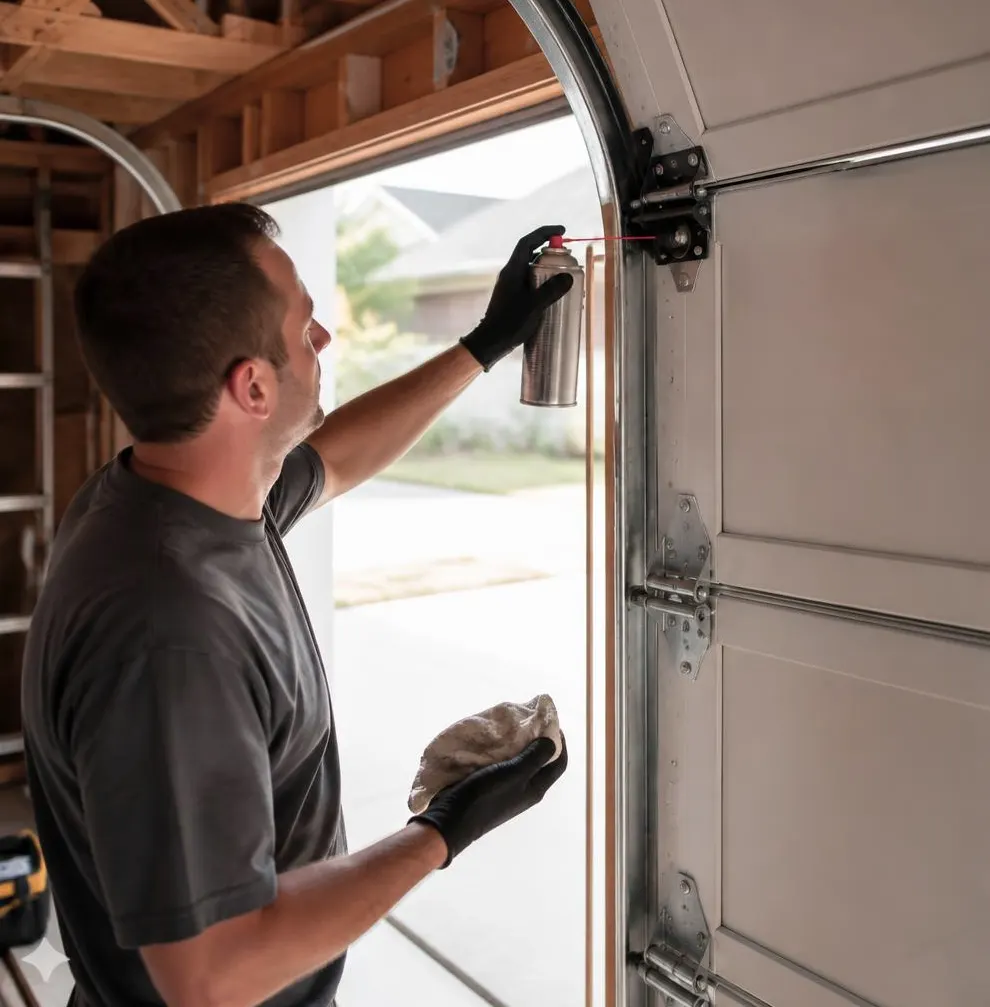
As a rule of thumb, if your garage door won't open, the problem is power, a safety sensor, or a spring, in that order of likelihood. The exceptions are real, though: a frayed cable, a dead opener logic board after a storm, or someone bumping the emergency release cord can all stop a door cold without touching springs or sensors at all. The fastest way to figure out which one you're dealing with is to work through the list the same way a technician does, instead of guessing.
What You're Probably Seeing
Before the cause, match your symptom to narrow things down:
- Nothing happens at all — no motor sound, no light. Usually power.
- Opener hums or runs, but the door doesn't move — usually a broken spring or disconnected trolley.
- Light on the opener blinks and it won't close or open fully — almost always a sensor issue.
- Door opens a few inches, then reverses or stops — often a sensor, sometimes a track obstruction.
- Door is physically stuck, feels locked — check the manual lock bar and the emergency release cord first.
First Check: Power and Connection
This sounds basic, but it's the fastest thing to rule out and the one homeowners skip. Check that the opener is plugged in and that the outlet has power — a tripped breaker or GFCI outlet in a damp garage is common, especially after heavy rain finds its way in around the outlet box. If the area's had any remnant storm activity with power flickers, a surge can also knock an opener's logic board offline even though the outlet itself is fine. A quick way to test: does the wall button work when you press it directly? If the opener is dead at the wall button too, it's power or the unit itself, not the door hardware.
Second Check: Safety Sensors
Every opener built in the last few decades has two small sensors low on each side of the track, and if they're misaligned, dirty, or blocked, the door won't close and in some cases won't open either. These sensors are an easy casualty of yard work — a leaf blower, a ladder, or even a stray basketball can knock one a fraction of an inch out of alignment. Humidity and condensation on the lenses, or a spider web built overnight, can also confuse them. The fix is simple: wipe both lenses clean, make sure nothing is sitting in the sensor path, and check that both small indicator lights are solid, not blinking. If they're aimed even slightly off from each other, loosen the mounting screw and nudge until both lights go solid.
Third Check: Broken Springs
If the opener runs but the door won't lift, or the door feels unusually heavy when you try to lift it by hand, suspect a broken spring. Homeowners sometimes hear it happen — a loud bang from the garage, often in cold snaps when an ice storm has made the metal more brittle, or simply from age and the stress of daily cycles. Springs carry the full weight of the door, and once one breaks, the opener motor isn't built to make up the difference; it'll strain, trip a breaker, or burn out trying. This is not a repair to attempt yourself. A broken torsion spring is under enough tension to cause serious injury, and the tools and know-how to measure and replace it safely are specialized. A proper spring replacement includes matching the spring to the door's weight and cycle life, not just swapping in whatever's closest, which matters for how long the fix lasts.
Fourth Check: Cables, Rollers, and the Opener Itself
If springs are intact but the door still won't move evenly, the next suspects are the lift cables, which can fray or rust where moisture collects near the bottom bracket, especially in garages that sit low or get splashback from heavy rain. A frayed cable can jam the door partway or let one side drop lower than the other. From here, a technician also checks the opener's internal gear, the trolley connection to the arm, and whether the limit settings have drifted, which can make the door think it's already open or closed when it isn't. Dead remote batteries and a stuck wall button are worth a quick look too, since they're the cheapest possible explanation and easy to rule out before anything else.
Don't Forget the Manual Lock and Release
Two things get overlooked because they're not mechanical failures at all: the manual lock bar on the inside of the door (sometimes bumped into the locked position by stored items) and the emergency release cord, which disconnects the door from the opener entirely if pulled. If the door won't engage with the opener but moves freely by hand, check that red cord before assuming something's broken.
When to Call Angier Garage Door
If you've checked power and sensors and the door still won't open, or you hear a bang and now the door feels like dead weight, stop trying to force it and call. That's exactly the kind of job our Spring Replacement and Garage Door Opener Repair & Installation services handle every week around Angier, Fuquay-Varina, and the rest of Harnett County. We'll diagnose which of these it is on-site, usually within minutes, and if it's after hours or you're stuck with the car trapped inside, our Emergency Garage Door Service covers that too.
If your garage door in Angier, NC won't open and you've run through the basics, give Angier Garage Door a call. We'll get it diagnosed and working again, the same day whenever we can.